Option one
Run it yourself
Installed into your own infrastructure — behind your VPN, on your own virtual machines, or handed to your IT team to deploy and own. All three of those are running in production today.
Field research operations
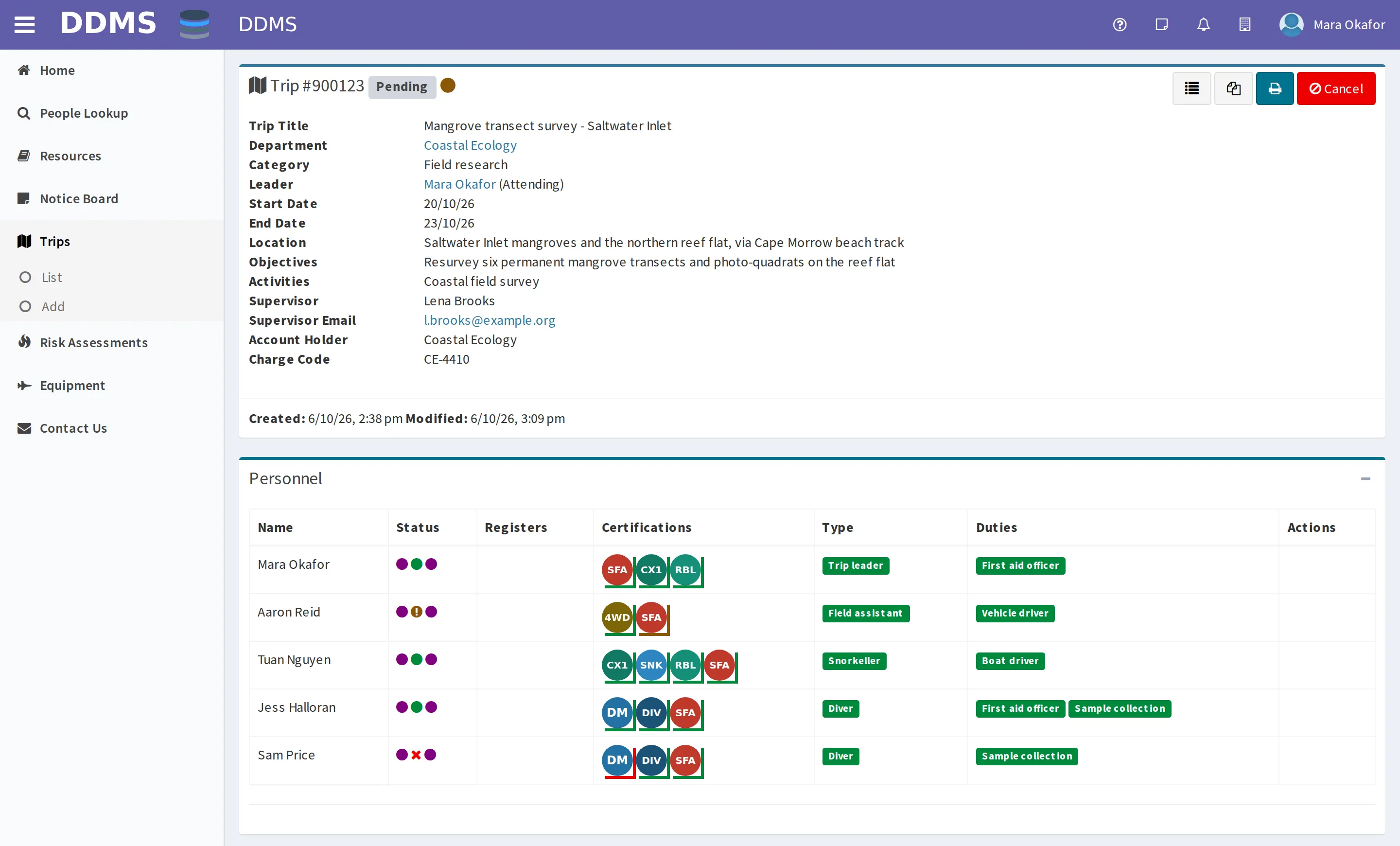
DDMS runs university field research operations — station bookings, transport, activity compliance, the risk assessment and the invoice, on one record. A dive survey, a day in the vehicles or a month of fieldwork overseas: everyone going is on the trip with their qualifications and currency, in front of whoever signs it off.
In use at Australian universities since 2014. Hosted in Australia, or installed in your own infrastructure.
Where it fits
Your enterprise system handles corporate risk. Whether a participant’s medical is current, or who is in the vehicle on Thursday, is faculty operations — and that is what DDMS keeps.DDMS coexists with the institutional platform — one client’s trips carry a cross-reference number to theirs. Faculty operations is a different problem from corporate risk, and it is the one DDMS was built for.
What it does
Book the station
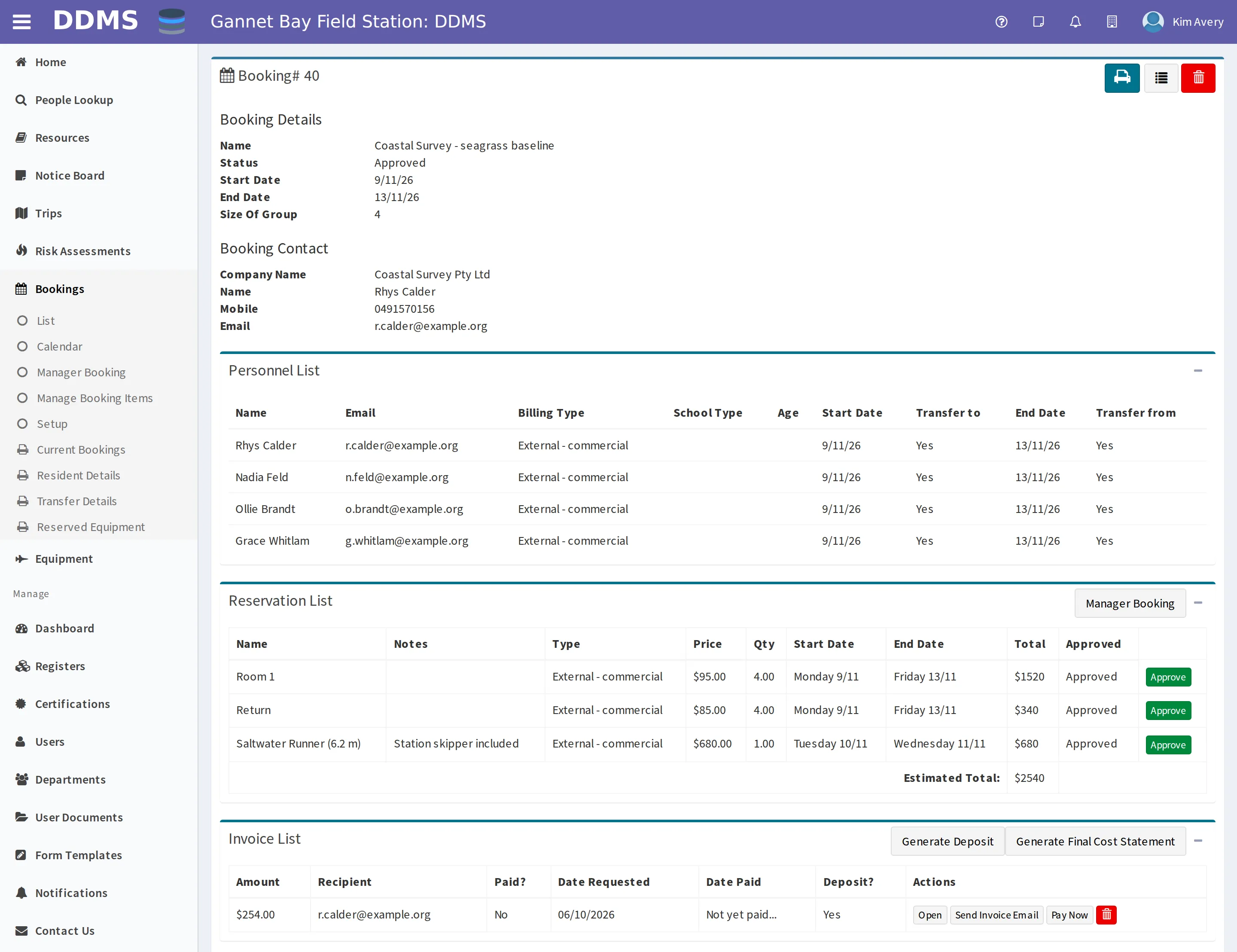
Accommodation, vessels, consumables and personnel are bookable items in one tree, each priced per client type. Availability and overbooking are checked as the booking is built; deposits, invoices, gateway payment and reminders fall out of it; and transfer schedules get people to and from the station on the right day.
Move the people
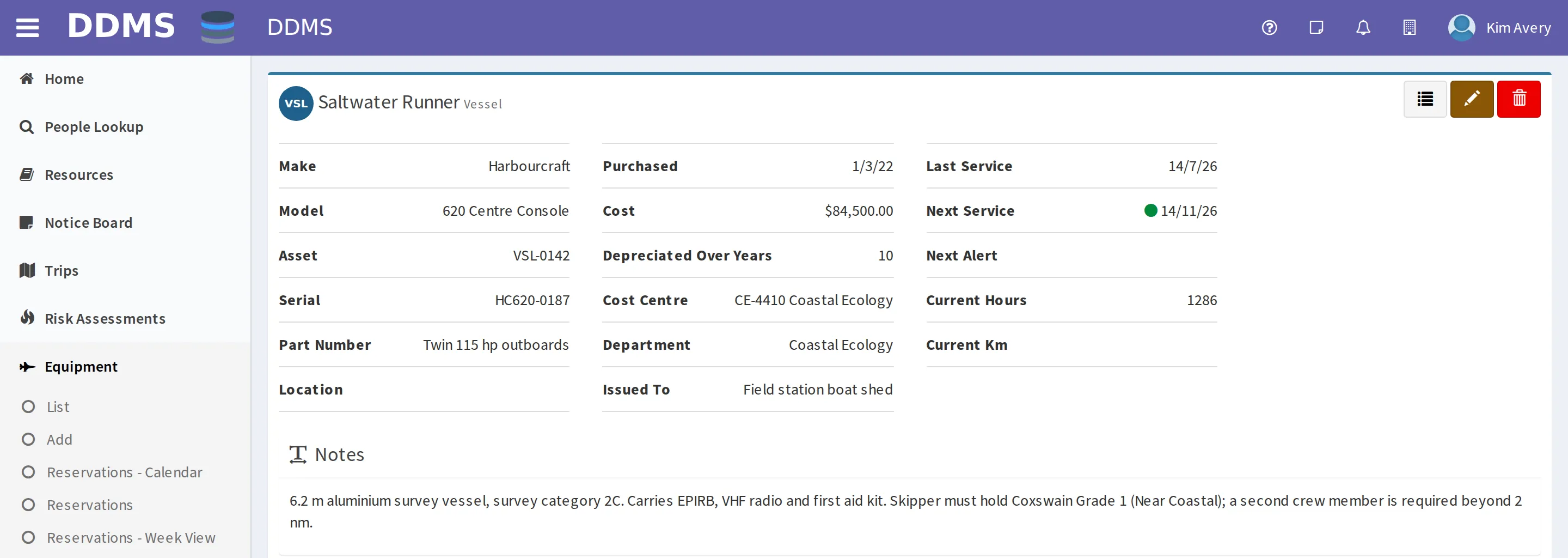
Finance-grade asset records — cost, cost centre, depreciation period, last and next service — combined with GPS tracks that upload and verify, vessel sea logs, and calendar reservation that attaches straight to a field trip.
Clear everyone going
Each trip type sets its own required forms, questions and roles, and a role names the induction it needs, so nobody fills it without one. Diving goes deepest: eight per-person qualification flags, dive medical, last dive and its depth, supervisor, snorkel-only and boat-driver designation, own or hire or lab gear. The trip carries its program, its log and the emergency management plan, and it approves with a name and a date.
| Person | Currency | Status |
|---|---|---|
| M. Okafor | Trip leader · first aid to 11 Jan 2027 | Leader |
| A. Reid | Driver · 4WD induction current | Cleared |
| T. Nguyen | Boat driver · snorkel only | Cleared |
| J. Halloran | Last dive 09 Nov 2024 | Currency |
| S. Price | Dive medical expired 30 Aug | Blocked |
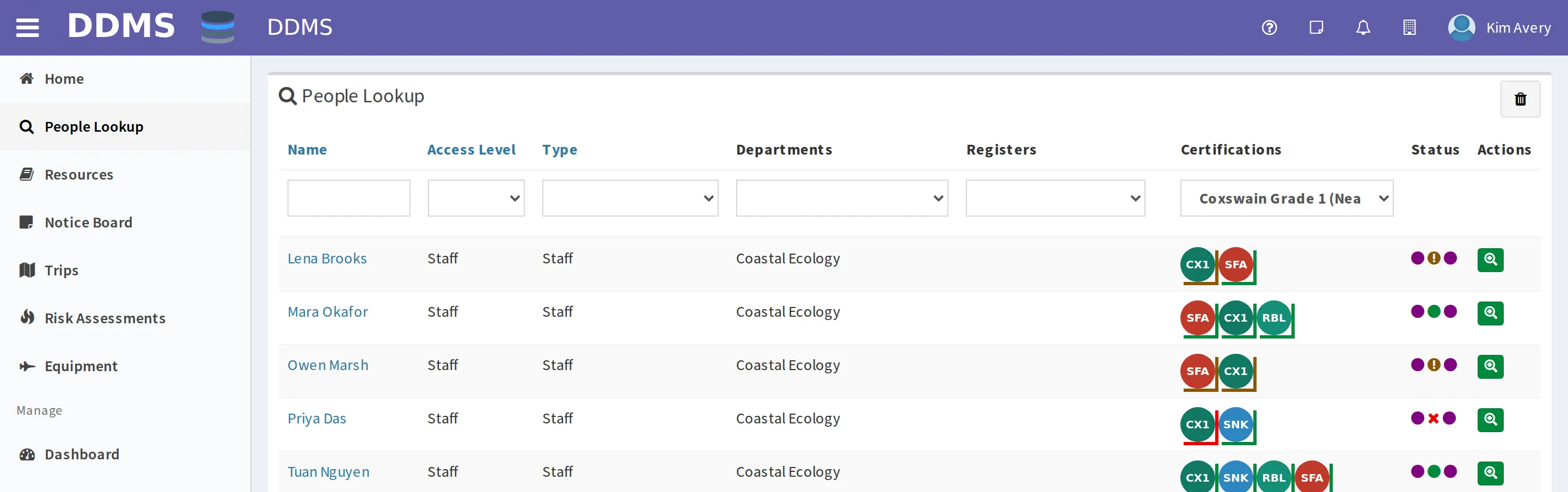
One diver’s medical has lapsed — the approver sees it on the trip.
Assess the risk
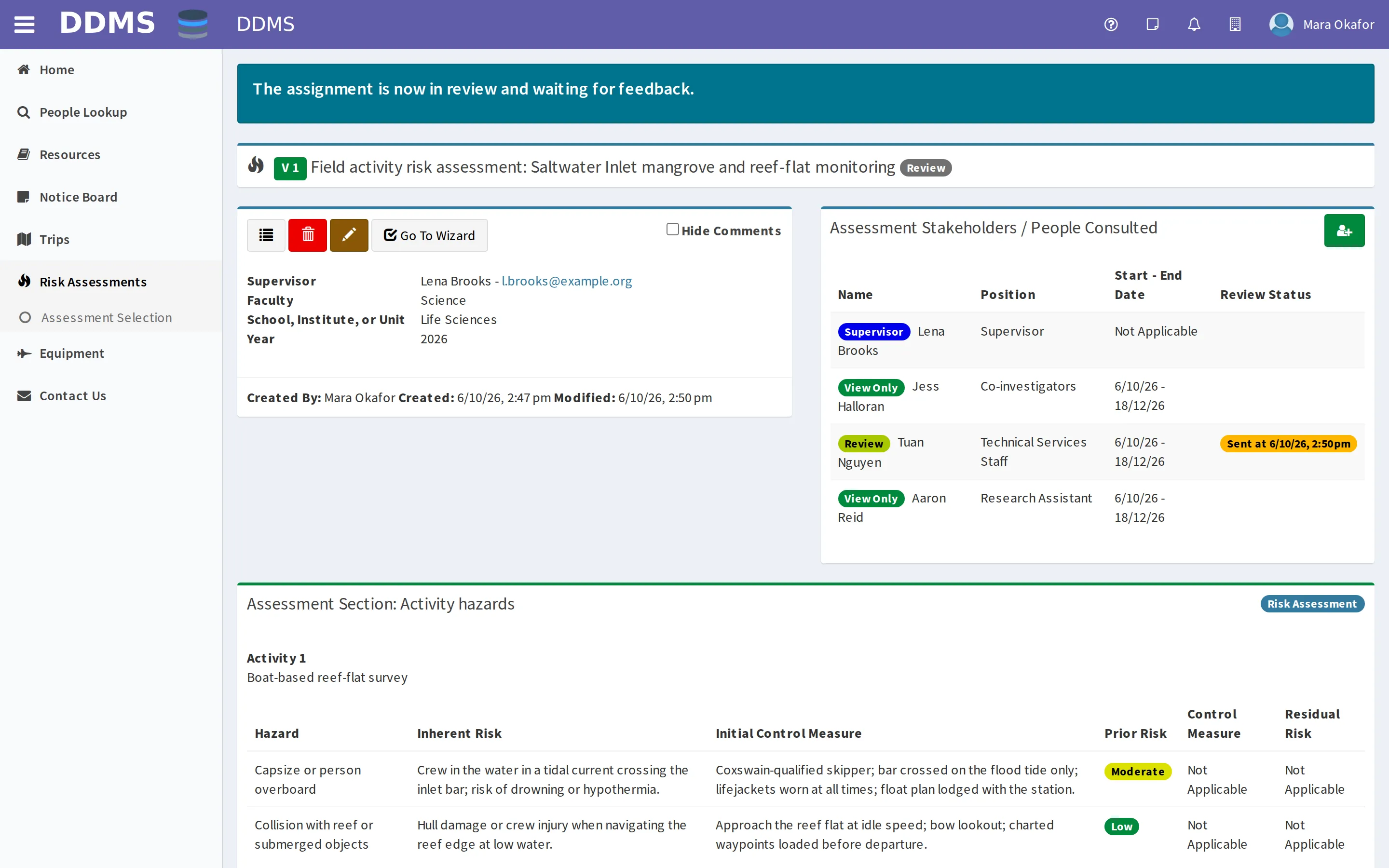
Version it, fork it for next year, transfer it when the supervisor changes. Circulate it to named stakeholders with the period they cover, collect their reviews — and recall them when the method moves underneath. Hazards rate against a matrix your institution configures.
Keep them qualified
Certifications expire into email and dashboard reminders, and the induction that depended on the lapsed certificate is flagged. Twenty-four dashboard tiles cover high-risk assessments, overseas fieldwork, trips awaiting supervisor sign-off, and what is booked next week.
Who it is built around, where it sits, and where it runs.
Station reservations, field trips, vehicles and vessels, and occupational diving compliance, each with its own records and rules.
Laid out around the work of whoever fills the bunks, books the vehicles and signs off the trips.
DDMS sits next to your institutional risk system rather than replacing it. A trip can carry the reference number of its record there.
Modules are enabled per facility, so two stations in one institution can run different halves of it.
Every client renames it. The product title, the logo text and the enabled modules are all settings.
Hosted by us in Australia with an uptime guarantee, or installed into your own infrastructure. Same product, same licence.
Option one
Installed into your own infrastructure — behind your VPN, on your own virtual machines, or handed to your IT team to deploy and own. All three of those are running in production today.
Option two
Hosted in Oracle Cloud ap-sydney-1, in Australia, with an uptime guarantee you choose — from 98% up to 99.999%. 99.9% is the standard recommendation.
The one-off installation and the yearly licence are the same either way; hosting is the only difference. Installation covers deployment, onboarding training, user guides and transfer of your existing data. The licence includes up to 1,000 users. Ask for current figures — we quote them rather than publish them, because a published price on a page goes out of date and this one has before.
Half an hour with someone who has built this for a university field station before. We will ask what you run — stations, vessels, diving, or all three — and show you those parts.
No slide deck, and no obligation.